Best Paper Chipboard Exporter & Supplier in UK
UK packaging converters, bookbinders, carton makers, and industrial buyers need paperboard that is consistent, practical, and easy to process. India can be a useful sourcing market for buyers who need flexible specifications and reliable bulk supply.
This guide covers paper-based chipboard, not wood particleboard. It explains key applications, technical specifications, quality checks, landed costs, and import requirements. It also shows how to evaluate Edicon Paper Product as a potential paper chipboard exporter from India. Buyers should confirm all product details, test results, certifications, order quantities, and delivery terms directly before placing an order.
What Is Paper Chipboard?
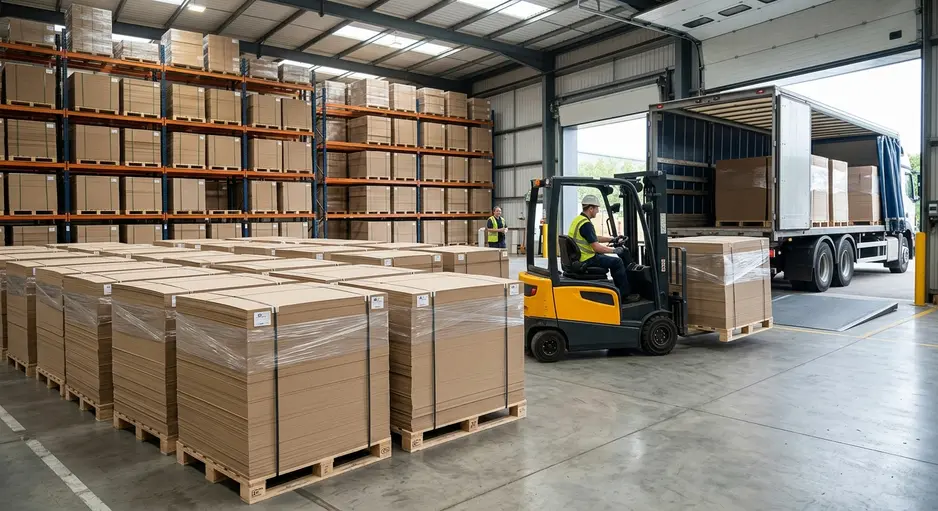
Paper Fibre Composition and Manufacturing
Paper chipboard is a dense, usually uncoated board made from compressed paper fibres. It may contain recovered fibre, making it a common form of recycled paperboard. Its firm structure makes it useful where stiffness, shape, and protection matter more than a decorative surface.
The finished quality depends on the paper fibre composition, pressing process, moisture control, density, and sheet finishing. These factors affect flatness, strength, cutting, gluing, and lamination. The material is often grey or brown, although its exact shade and surface can vary between batches and grades.
Grey Chipboard vs Other Paperboards
Grey chipboard, also called grey board, is not the same as folding boxboard, corrugated board, solid board, or wood-based chipboard. Folding boxboard often has a smoother printable face. Corrugated board uses fluted layers, while wood chipboard is made from wood particles and resin.
Buyers should therefore use terms such as grey chipboard, rigid paperboard, or paperboard chipboard for packaging when requesting quotations in the UK.
Is Recycled Paper Chipboard Sustainable?
Recycled paper chipboard can reduce the need for virgin fibre and may be recyclable after use. Its actual environmental outcome depends on its fibre content, coatings, adhesives, laminates, contamination, and local collection system.
It is safer to describe the product as a potential sustainable paper packaging material rather than making broad claims such as “fully eco-friendly.” Buyers should request evidence for recycled-content and responsible-sourcing claims.
Why Source Paper Chipboard from India?
Manufacturing Capacity and Customisation
A paper chipboard manufacturer in India may offer several thicknesses, grammages, sheet dimensions, and cutting options. This can support packaging, stationery, binding, and industrial production. However, capabilities differ between factories, so buyers must confirm the available range in writing.
Custom sizes can improve production yield and reduce cutting waste. Before ordering, ask whether the requested dimensions are standard, cut from larger sheets, or produced as a dedicated run. Each option may affect minimum quantities and lead time.
Price vs Total Landed Cost
The lowest price per sheet or tonne is not always the lowest overall cost. UK buyers should compare the full landed cost, including:
- Ex-works, FOB, CFR, or CIF price
- Ocean freight and insurance
- Customs clearance and applicable duty
- Import VAT
- Port and handling charges
- Inland delivery
- Pallet or container utilisation
- Losses caused by damage or rejected material
Supply Continuity for UK Buyers
A dependable paper chipboard exporter company should be able to discuss production planning, raw-material supply, repeat-order consistency, and contingency measures. Clear communication is also essential when the buyer and factory work in different time zones.
Ask for realistic production and dispatch dates. A useful schedule should separate manufacturing time, inland transport, port handling, sea transit, customs clearance, and final UK delivery.
Paper Chipboard Applications in the UK
Chipboard for Packaging and Cartons
Chipboard for packaging is used in rigid box cores, reinforcement panels, backing sheets, layer pads, dividers, and partitions. Paper chipboard for cartons may add stiffness or help separate products during handling.
Suitability depends on the package design, product weight, stacking conditions, and expected level of impact. Samples should be tested in the final pack before the board is approved for structural or protective use.
Paper Chipboard for Bookbinding
Common bookbinding applications include hardback covers, notebooks, diaries, files, folders, photo albums, puzzles, and game boards. In these uses, flatness and dimensional consistency are especially important.
Paper chipboard for bookbinding should cut cleanly and bond well with the chosen adhesive. Buyers should also check for curl, dust, edge damage, and warping after gluing or lamination.
Paper Chipboard for Industrial Packaging
Paper chipboard for industrial packaging can be used for pallet layer sheets, component separation, product stabilisation, interleaving, and surface protection. The required compression strength and stiffness will vary with the load and transport conditions.
Paperboard should not be assumed to resist prolonged moisture exposure unless the supplier confirms a suitable treatment. Performance trials should reflect the actual warehouse, shipping, and handling environment.
Printing, Lamination and Die Cutting
Converting performance depends on density, moisture, fibre structure, surface smoothness, and sheet flatness. Buyers should assess glue adhesion, scoring, die cutting performance, and printing compatibility on their own equipment.
Standard grey chipboard may not provide the finish needed for premium graphics. It is often covered or laminated with printed paper when appearance is important.
Which Paper Chipboard Specifications Matter?
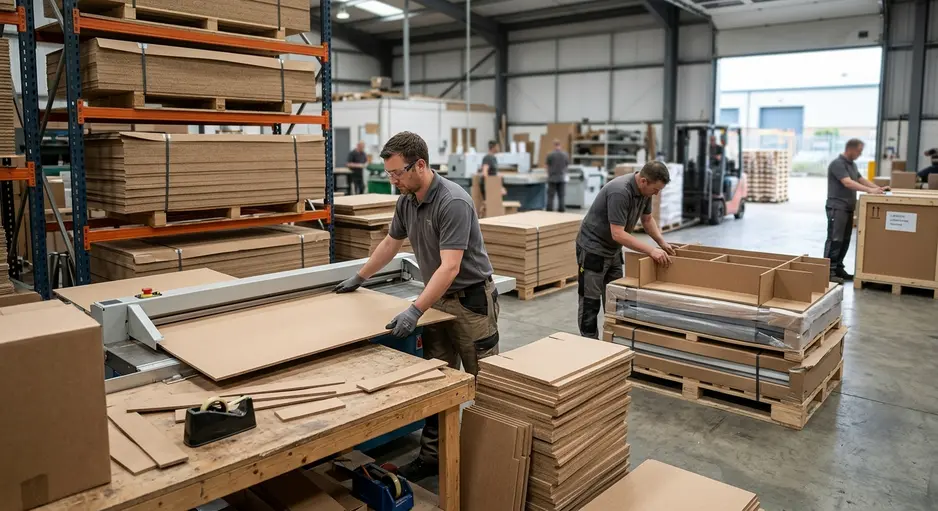
Board Thickness Options and Tolerances
Thickness, also called caliper, affects rigidity and fit. Nominal thickness is the stated target, while actual readings may vary within an agreed tolerance. This variation matters for rigid boxes, binding lines, cutting dies, and automated feeding equipment.
Do not test only one point on one sheet. Measure several areas across multiple chipboard sheets from the sample batch. For formal evaluation, buyers can agree on a recognised method such as ISO 534 or an equivalent standard.
Grammage Specifications and Density
Grammage is the board’s mass in grams per square metre, commonly shown as GSM. ISO 536 is a recognised method for measuring paper and board grammage. Thickness and GSM should be reviewed together because neither value alone gives a complete view of performance.
A high density board may feel firmer at a given thickness, but density must remain consistent. Buyers should request target values, permitted tolerances, and the test method used by the supplier.
Bending and Compression Strength
Bending strength or resistance matters in hard covers, backing boards, dividers, and rigid packaging. Compression strength is important when the board must support loads, separate products, or retain shape during storage.
The machine and cross directions may perform differently. Ask for both values when direction affects the finished product. ISO 2493 can be considered when agreeing on bending resistance testing. Internal bond and delamination performance may also matter during cutting, scoring, and gluing.
Surface Smoothness and Sheet Flatness
A stable, even surface supports clean lamination, adhesive coverage, printing, and die cutting. Inspect samples and incoming deliveries for:
- Curling or warping
- Edge and corner damage
- Paper dust
- Surface contamination
- Unusual odour
- Thickness variation
- Delamination
- Inconsistent colour
Moisture Resistance and Storage
Standard paper chipboard is sensitive to moisture and should not be described as waterproof. Moisture changes can affect size, stiffness, flatness, and converting results. Water absorptiveness may be assessed through the Cobb method under ISO 535 or another agreed method.
Ask how sheets are wrapped and protected for ocean freight. Store pallets in a dry area, away from walls and direct floor contact. Allow the material to acclimatise before converting, especially when warehouse and production temperatures differ.
Specification Checklist
- Thickness: Confirm the nominal caliper and tolerance.
- Grammage: State the required GSM range and test method.
- Density: Check consistency across sheets and batches.
- Moisture: Agree on the target range and packing method.
- Sheet size: Confirm dimensions, tolerances, and grain direction.
- Strength: Match bending and compression needs to the application.
- Surface: Define limits for dust, marks, and roughness.
- Recycled content: Request evidence for any stated percentage.
How Do You Choose a Paper Chipboard Supplier?
Request Samples and Technical Data
Ask for representative production samples rather than hand-selected presentation pieces. The technical pack should cover available sizes, thickness and grammage tolerances, moisture, recycled content, and relevant test data.
Test the board on the equipment used for printing, binding, laminating, gluing, scoring, or die cutting. A board that looks acceptable may behave differently at normal production speed.
Review Quality-Control Procedures
Ask how often thickness and grammage are measured, how rejected sheets are handled, and whether each shipment can be traced to a production batch. Buyers should also confirm whether pre-shipment inspection is available.
Ocean freight can expose pallets to movement and humidity. Check the wrapping, corner protection, strapping, pallet condition, and container-loading plan before approving a shipment.
Compare MOQ, Capacity and Lead Time
Confirm the minimum order quantity, trial-order policy, monthly capacity, standard sizes, custom options, production lead time, and loading quantity. Repeat orders should match the approved specification, not just the general product name.
Verify Sustainability Claims
Do not rely on a logo alone. Request current certificates and check the certificate number, scope, facility, and covered products with the issuing body. Recycled content, recyclability, FSC claims, and PEFC claims describe different matters and should not be treated as equal.
A practical supplier scorecard can weight quality consistency, landed cost, delivery history, technical support, documentation, sustainability evidence, and payment terms.
Importing Paper Chipboard from India to the UK
Confirm the Commodity Code
The correct commodity classification depends on the board’s material, construction, finish, and intended form. UK importers should verify the current code through the UK Trade Tariff or a qualified customs specialist. An unverified code should not be applied to every grade.
Essential Export and Import Documents
Depending on the shipment and contract, documents may include:
- Commercial invoice
- Packing list
- Bill of lading
- Certificate of origin when required
- Insurance documents
- Product specification or test report
- Pallet or fumigation documents where applicable
- Contractually required chain-of-custody records
Incoterms, Freight and UK Responsibilities
The quotation should state the Incoterm, loading port, destination, insurance responsibility, customs arrangements, and final delivery point. Buyers should also plan for demurrage or detention if clearance or unloading is delayed.
A business placing packaging on the UK market may face packaging data, waste, and Extended Producer Responsibility duties. The importer should review current GOV.UK guidance and obtain professional advice when needed.
Evaluating Edicon as a Paper Chipboard Exporter

Information UK Buyers Should Request
UK buyers considering Edicon Paper Product should request verified details about available grades, sheet sizes, thickness, grammage, recycled fibre content, packing, MOQ, production capacity, quality checks, lead times, and Incoterms.
Any claim about certification, export reach, or manufacturing capacity should be supported by current documents. These details should also appear in the quotation or agreed purchase specification.
Start with a Trial Order
- Share the application and required performance.
- Request samples and technical data.
- Run converting and end-use trials.
- Approve a signed reference sample.
- Add measurable tolerances to the purchase order.
- Begin with a controlled commercial shipment.
- Review incoming inspection results before scaling volume.
Best Paper Chipboard Exporter & Supplier in UK
Choose on Evidence, Not Claims
Selecting a paper chipboard supplier in UK sourcing channels requires more than comparing prices. Define the application, set measurable specifications, test production samples, and calculate the full landed cost. Confirm the commodity code, documents, packing method, and delivery responsibilities before shipment.
Edicon Paper Product can be evaluated as a potential paper chipboard exporter from India through an evidence-led process. Begin with technical discussions and a trial order. When board quality, converting performance, service, and delivery all meet the agreed standard, buyers can scale supply with greater confidence.
Frequently Asked Questions
1. What is paper chipboard called in the UK?
It may be called greyboard, grey chipboard, recycled paperboard, or rigid paperboard. The word “chipboard” alone often means wood particleboard in the UK. Use “paper chipboard” in enquiries to prevent confusion.
2. Is grey paper chipboard recyclable?
Untreated fibre-based greyboard is often recyclable. However, plastic coatings, laminates, adhesives, contamination, and local collection rules can affect acceptance. Buyers should check the finished pack, not only the base board.
3. Which chipboard thickness is best for packaging?
There is no single best thickness. The choice depends on box size, product weight, construction, converting method, stacking load, and required rigidity. Test several samples in the intended package before final approval.
4. Can paper chipboard be printed and die-cut?
Yes, but results depend on density, moisture, fibre composition, surface quality, print process, and die condition. Greyboard is often laminated with printed paper when a decorative finish is needed.
5. What should I ask an exporter from India?
Ask about samples, test methods, tolerances, recycled content, MOQ, capacity, lead time, export packing, container loading, documents, Incoterms, batch traceability, and complaint handling.