Chipboard Thickness & GSM: A Guide to Packaging Applications
Choosing packaging board by GSM alone can lead to weak boxes, poor product fit, excess weight, or die-cutting problems. A better choice considers both chipboard thickness and GSM, along with density, stiffness, moisture, and the final box design.
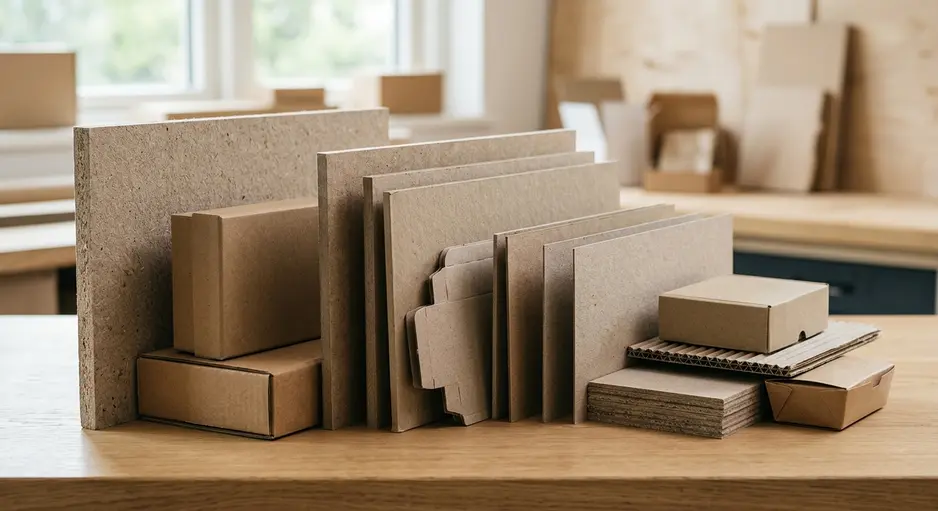
Packaging chipboard is a dense paperboard commonly made from recycled paper fibres. Depending on the market, it may be called greyboard, recycled board, or unlined chipboard. It is different from the wood-particle board used in furniture. This guide explains key measurements, typical application ranges, performance factors, and the details to include in a supplier request.
What Do Chipboard Thickness and GSM Mean?
Chipboard GSM Measures Basis Weight
GSM means grams per square metre. A 700 GSM sheet weighs 700 grams for every square metre of material. This measurement is also known as grammage or basis weight.
Chipboard GSM helps buyers compare material use, sheet weight, and production consistency. However, it does not confirm exact thickness or strength. Two sheets with the same grammage may perform differently because their fibre mix, density, moisture, and production methods are not identical.
Grammage is commonly measured according to ISO 536 or TAPPI T 410. These methods give buyers and suppliers a shared basis for comparing paper chipboard specifications.
Board Caliper Measures Physical Thickness
Chipboard thickness, or board caliper, is the distance between the two surfaces of a sheet. It may be stated in millimetres, microns, or points. One point equals 0.001 inch, or 0.0254 mm.
Caliper affects product fit, edge appearance, cutting setup, and wrapping allowances. It should always be supplied with a tolerance because natural fibre board can vary across a sheet or production batch. ISO 534 and TAPPI T 411 provide recognized methods for measuring thickness and apparent density.
Why GSM Does Not Convert Directly to Millimetres
There is no universal conversion from chipboard GSM to millimetres. Paperboard density changes with fibre furnish, pressing, moisture content, ply construction, and surface treatment.
For example, a 900 GSM board with a measured thickness of 1.5 mm has an apparent density of about 600 kg/m³. This calculation describes that specific board. It does not prove that every 900 GSM sheet will measure 1.5 mm.
Which Matters More for Packaging: GSM or Thickness?
Thickness Influences Rigidity and Box Shape
Greater thickness generally improves bending stiffness and resistance to flexing. This can help rigid boxes retain sharp panels and a premium feel. Yet performance also depends on paperboard density, fibre quality, grain direction, and moisture.
Bending resistance can be tested under ISO 2493. Results should be reviewed in both the machine direction and cross direction because a board may be much stiffer in one direction.
GSM Indicates Material Content
Grammage is useful for comparing sheet weight, material usage, freight weight, and lot consistency. A higher GSM sheet contains more mass per square metre, but it is not always thicker or stiffer. A dense, heavily pressed board may be heavier while remaining relatively thin.
Strength Depends on the Complete Package
Neither number can predict finished box performance on its own. Compression strength, edge strength, stacking strength, package geometry, joints, inserts, lamination, humidity, and product load all matter.
Tests designed for corrugated board, such as the edge crush test, should not be treated as direct measures of solid chipboard performance. When stacking is critical, test the completed package under realistic loads and storage conditions.
Chipboard Thickness and GSM Guide by Application
The following ranges are starting points rather than universal specifications. Actual requirements should be confirmed with production-grade samples, prototypes, and performance tests.
Light Folding Cartons
Illustrative range: 250–600 GSM and 0.3–0.8 mm.
Thin board may suit light cartons that need to fold and crease cleanly. Important factors include folding endurance, grain direction, surface smoothness, print quality, and resistance to cracking. Not every folding-carton grade is sold under the trade term “chipboard,” so confirm the exact board construction.
Dividers and Protective Inserts
Illustrative range: 350–1,000 GSM and 0.5–1.5 mm.
Dividers and inserts depend on accurate fit, clean slots, edge strength, and reliable die cutting performance. The correct choice depends on product weight and how the insert spreads force inside the package.
Backing Boards and Pads
Illustrative range: 500–1,500 GSM and 0.7–2.0 mm.
Backing pads need flatness, stiffness, dimensional accuracy, and clean cut edges. These chipboard sheets for packaging can support products, separate layers, or protect surfaces during handling.
Rigid Setup Boxes
Illustrative range: 800–2,000 GSM and 1.0–3.0 mm.
Chipboard for rigid packaging is often wrapped with printed or decorative paper. Common uses include gift, cosmetic, jewellery, electronics, and luxury product boxes. Board tolerance, corner construction, cavity fit, wrap allowance, and adhesive behaviour matter as much as nominal weight.
Heavy-Duty and Industrial Packaging
Illustrative range: 1,200–3,000+ GSM and 1.5–4.0+ mm.
Chipboard for industrial packaging may be used for separators, pallet pads, reinforcement panels, and protective layers. For concentrated or uneven loads, laminated plies, internal supports, or a structural redesign may work better than simply increasing grammage.
How Board Specifications Affect Packaging Performance

Compression and Stacking Strength
A thick panel may resist bending, but stacking performance comes from the whole packaging system. Product shape, load distribution, corners, joints, and internal supports all affect the result. GSM alone cannot predict compression strength.
Use finished-package compression or load testing when boxes will be stacked in warehouses or during transport. Tests should reflect expected stacking height, duration, and humidity.
Surface Smoothness and Printing Compatibility
Unlined recycled board may show fibre texture, dust, colour variation, and higher surface porosity. Some grades can be printed directly, but results depend on ink holdout and surface preparation.
When appearance is important, lined chipboard, coating, lamination, or a printed outer wrap may provide a cleaner finish. Test inks, coatings, foil stamping, and adhesives on the intended production material.
Die Cutting and Creasing
Chipboard board thickness affects knife setup, creasing channels, stripping, and cutting pressure. Poor setup can cause crushed edges, cracking, delamination, or incomplete cuts.
Grain direction also matters. A crease made against the preferred direction may require different tooling and can be more likely to crack. Converters should use the approved thickness tolerance when selecting cutting and creasing equipment.
Moisture Resistance and Stability
Recycled paper fibres absorb moisture from the air. Changes in humidity can cause curling, expansion, warping, and lower compression performance. Water absorptiveness can be assessed with the Cobb method under ISO 535.
Boards should be stored flat, dry, and away from direct floor contact. Protective wrapping is important during storage and export shipping. Conditioning under ISO 187 can improve consistency before testing or conversion.
Folding Endurance and Ply Bond
Folding endurance is important for cartons, hinged structures, and repeated-opening designs. ISO 5626 provides a recognized testing framework. Laminated board also needs a sound ply bond so its layers do not separate during cutting, wrapping, or use.
Verify performance after printing, coating, and lamination. Adhesive moisture, heat, and pressure can change the behaviour of the original sheet.
How to Choose Chipboard for Packaging
1. Define the Product and Distribution Risks
Begin with the product rather than a generic conversion chart. Record:
- Product dimensions, shape, and weight
- Fragility, value, and surface sensitivity
- Expected stacking height and storage time
- Shipping method and handling risks
- Temperature and humidity exposure
- Retail display and finish requirements
- Recycled-content or sustainability goals
2. Start With Structural Requirements
Select an initial chipboard thickness for packaging based on stiffness, protection, and box geometry. Decide whether the material must fold, stay rigid, separate products, or support a load.
Consider inserts, ribs, reinforced corners, and better load distribution before choosing a much heavier sheet. Good structural design can reduce material while improving protection.
3. Compare GSM, Caliper, and Density
Ask for chipboard GSM and measured caliper together. Also request apparent density, thickness tolerance, and stiffness in both grain directions. Avoid approving a grade described only as “1 mm board” or “1,000 GSM board.”
4. Test Converting Compatibility
Run production-representative trials for die cutting, creasing, laminating, wrapping, adhesive bonding, printing, embossing, and foil stamping. Small hand-cut samples may not reveal problems that occur at production speed.
5. Prototype the Finished Package
Test product fit, handling, drops, compression, and stacking as relevant. Condition samples at the expected temperature and relative humidity. Production sheets should match the approved sample for thickness, flatness, grain direction, and converting performance.
Real-World Specification Examples
Premium Cosmetic Rigid Box
A converter might begin with approximately 1.5 mm greyboard in a suitable GSM range. The final specification will depend on the product cavity, box size, corner sharpness, wrap paper, adhesive, and desired hand feel.
A denser sheet may weigh more without providing the same visual bulk as a lower-density sheet of equal grammage. This is why chipboard for product packaging should be evaluated by touch, appearance, construction, and test results.
Industrial Component Packaging
A heavy component may require laminated board, reinforced corners, or internal supports. Increasing GSM alone may not solve panel bowing or damage from a concentrated load. Testing the complete pack is more reliable than comparing sheet data alone.
Tips That Prevent Common Failures
- Specify both grammage and caliper with tolerances.
- Record grain direction on orders and cutting plans.
- Approve samples made from production-grade material.
- Test after lamination because adhesive moisture may cause warping.
- Allow sheets to condition before conversion.
- Check recyclability after adding films, foils, magnets, or laminates.
- Verify contact, migration, odour, and cleanliness requirements for sensitive products.
What Should You Ask a Chipboard Supplier?

Paper Chipboard Specifications for an RFQ
A clear request for quotation helps suppliers recommend a suitable grade. Include or request:
- Grade name and intended packaging application
- Grammage and permitted tolerance
- Thickness and permitted tolerance
- Apparent density
- Sheet size, squareness, and size tolerance
- Grain direction and moisture level
- Recycled fibre content
- Flatness and acceptable warpage
- Bending stiffness in both directions
- Surface and print-side information
- Cobb value or other water absorption data
- Ply bond or delamination performance
- Relevant declarations, test reports, and certifications
Supplier Evaluation Questions
Ask whether technical data sheets, certificates of analysis, and production samples are available. Confirm minimum quantities, lead times, lot traceability, custom sheet sizes, laminated options, and moisture protection during shipping.
A supplier should also understand the actual box design. Share drawings, product weight, converting methods, and performance needs rather than requesting chipboard packaging material by price or GSM alone.
Explore Chipboard Thickness & GSM
Choose Specifications Based on Real Performance
The best packaging choice comes from evaluating thickness, grammage, density, stiffness, moisture behaviour, and box design together. Avoid relying on a generic GSM-to-millimetre chart or assuming that more material always delivers better protection.
Test actual sheets in the intended construction and distribution environment. For specification details, sample availability, custom sheet options, and quotation support, speak with Edicon Paper Product about your product, converting process, and performance requirements.
Frequently Asked Questions
1. What GSM chipboard is best for packaging?
There is no single best GSM. The right choice depends on package type, box size, product weight, required stiffness, board density, and converting method. Compare grammage with caliper and test the finished package.
2. What thickness is used for rigid boxes?
Rigid boxes commonly use board around 1–3 mm thick. Small or light boxes may use less, while larger or heavy-duty designs may need more. Wrap thickness, corner design, inserts, and product fit also affect the choice.
3. Can chipboard GSM be converted to thickness?
Not accurately without knowing apparent density. Divide GSM by thickness in millimetres to calculate density in kg/m³. For purchasing, use the supplier’s measured caliper rather than a general conversion chart.
4. Is thicker chipboard always stronger?
No. Extra thickness often improves rigidity, but strength also depends on fibre quality, density, grain direction, moisture, ply bond, and package design. A poorly designed thick box may perform worse than a well-supported thinner one.
5. What is the difference between chipboard and greyboard?
The terms often overlap in packaging and may describe recycled, unlined paperboard. However, naming and surface construction vary by supplier and region. Always compare the technical data rather than relying on the grade name.