200 GSM or 300 GSM: Which Paper Thickness is Right for You?
Choosing the ideal paper thickness can significantly influence the quality, appearance, and durability of your printed materials. Whether you’re designing marketing brochures, watercolor artwork, certificates, packaging, or premium photo prints, both 200 gsm paper and 300 gsm paper serve unique purposes and bring distinct advantages. Understanding these differences helps you pick the most suitable option for your project, ensuring a refined and professional finish every single time.
In this comprehensive guide, we break down paper GSM, dive deep into the characteristics of both paper thicknesses, and help you decide which one best fits your creative or business needs.
What Does GSM Mean in Paper?
GSM stands for Grams per Square Meter, which represents the weight and thickness of a single sheet of paper. The higher the number, the thicker, heavier, and more rigid the paper will feel. This measurement plays a crucial role in printing, design, packaging, and professional artwork.
Here’s what GSM actually influences:
• Durability: Thicker paper withstands frequent handling, bending, and environmental exposure better than lighter sheets. This becomes important for business cards, packaging sleeves, certificates, and premium prints.
• Printing Quality: Higher GSM paper absorbs ink differently and offers stronger color clarity, richer tones, and more defined lines. Designers and photographers often prefer thicker paper for premium looks.
• Flexibility vs Rigidity: Lower GSM sheets bend more easily and feel lighter, whereas higher GSM sheets maintain their shape and structure even under stress, making them ideal for calling cards, tags, and covers.
• Purpose & Use Case: GSM essentially determines whether the paper is suitable for writing, printing, sketching, painting, covering, or packaging. Choosing incorrectly can affect both aesthetics and functionality.
Understanding GSM helps you avoid common mistakes such as selecting a thinner paper for heavy artwork or choosing an overly thick sheet for regular printing jobs.
What is 200 GSM Paper?

200 gsm paper falls under the moderately thick category, offering an excellent balance between affordability, flexibility, and durability. It feels noticeably thicker than regular printer sheets yet remains lightweight enough to fold, score, crease, and print with ease.
Characteristics of 200 GSM Paper
• It has a semi-rigid feel, meaning it can stand upright but still bends comfortably without cracking.
• The surface is usually smooth, offering good ink absorption for crisp text and sharp images.
• It provides a premium feel without the heaviness or rigidity of 300 GSM, making it suitable for everyday professional printing.
Common Applications of 200 GSM
• Marketing Materials (Flyers, Posters, Brochures): 200 GSM retains shape well and elevates the visual appeal of promotional prints without raising costs excessively.
• Cards & Invitations: When used for simple greeting cards or foldable invitations, 200gsm cardstock offers enough firmness without making folding difficult.
• Photo Prints Using 200 GSM Photo Paper: The weight supports clear, vibrant photo reproduction while remaining printer-friendly and economical.
• Menu Cards & Product Sheets: Many restaurants and product brands prefer it for single-sheet menus, as it resists tearing but remains flexible for lamination.
• Light Packaging with 200 GSM Kraft Paper: For smaller items, tags, eco-friendly wrappers, and pouches, 200 gsm kraft paper provides strength without excess bulk.
Strengths of 200 GSM
• Budget-friendly choice: Offers a premium look at a reasonable cost, allowing high-volume printing for businesses.
• Versatile printing compatibility: Works well with most home and office printers.
• Easy to fold & crease: Ideal when your designs require folding lines or booklet formats.
• Lightweight & practical for mass production: Perfect for marketing campaigns, product catalogs, and mailers.
Limitations of 200 GSM
• Not as stiff as 300 GSM, especially when used for heavy or moisture-sensitive projects.
• Less suitable for luxury printing where a rich, rigid feel is required.
• May curl at the edges over prolonged usage, especially in humid regions.
What is 300 GSM Paper?
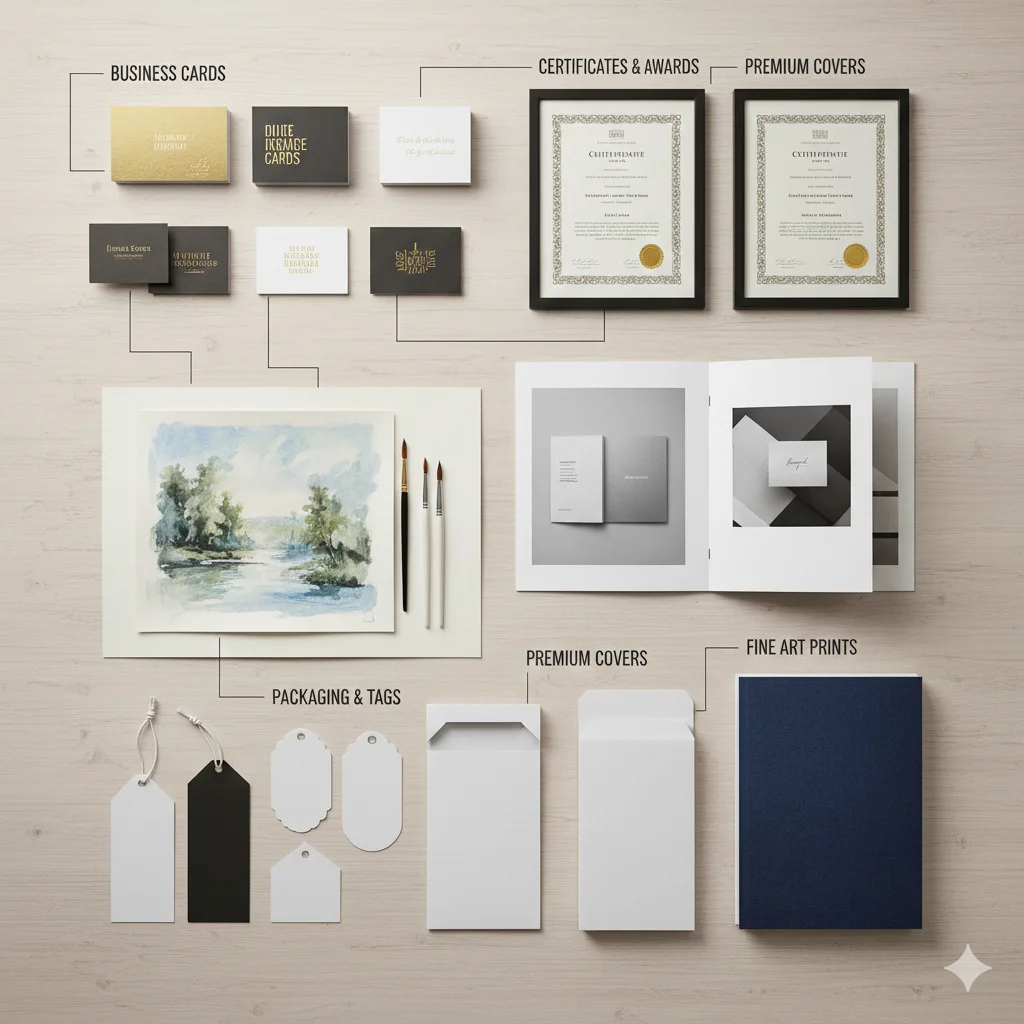
300 gsm paper is a significantly thicker, more premium-grade option. It feels rigid, luxurious, and sturdy much like the thickness used for business cards, art prints, and heavy-duty covers.
Characteristics of 300 GSM Paper
• Has a noticeably heavy and rigid structure that maintains shape even under pressure.
• Excellent for textures and finishes such as matte, gloss, silk, or embossed surfaces.
• Highly preferred by artists, designers, luxury brands, and packaging specialists for long-lasting results.
Popular Uses of 300 GSM Paper
• Business Cards: A thick and professional feel is essential for high-impact first impressions.
• Premium Brochure & Catalog Covers: 300 gsm paper thickness gives a luxury finish that helps brand credibility.
• Certificates & Achievement Awards: Adds value and longevity to important documents.
• Watercolor Paper 300gsm: Popular among artists because it supports heavy water application without warping or pilling.
• Packaging Sleeves & Rigid Product Tags: Offers the structure needed for packaging beauty brands, jewelry, clothing, and premium goods.
• High-quality Art Prints: Photographers and illustrators often use 300 gsm paper for printing collectible artworks.
Strengths of 300 GSM
• High durability & strength: Perfect for prints meant to last.
• Superior ink handling: Offers richer depth, contrast, and vibrancy in printed colors.
• Luxurious finish: Great for branding that requires a premium feel.
• Supports artistic techniques: Watercolor textures and mixed media perform far better on 300gsm surfaces.
Limitations of 300 GSM
• Challenging for low-end home printers to feed smoothly due to its thickness.
• More expensive than 200 GSM, especially for mass printing.
• Less suitable for folded or multi-page documents, as it becomes bulky.
Comparison Table: 200 GSM vs 300 GSM Paper
| Feature | 200 GSM Paper | 300 GSM Paper |
|---|---|---|
| Thickness | Medium | Thick & Rigid |
| Ideal For | Flyers, posters, simple cards, menus | Business cards, certificates, premium covers |
| Flexibility | High | Low |
| Durability | Good | Excellent |
| Printing Quality | Sharp & clear | Rich, premium & high-depth |
| Cost | More affordable | More premium-priced |
| Artistic Use | Basic sketches, light paints | Watercolor, acrylic, mixed media |
| Packaging | Light packaging, tags | Premium product packaging |
Which GSM Should You Choose Based on Your Project?
Selecting the correct paper thickness depends on your purpose, handling requirements, and final appearance expectations.
1. For General Business Printing
If you’re printing marketing materials like flyers, promotional sheets, product descriptions, or posters, 200 gsm paper is the ideal balance of price and quality. It gives a refined look while keeping costs manageable for bulk printing.
2. For Premium Business Cards or Luxury Branding
300 gsm paper stands out instantly because of its professional thickness. It communicates quality, seriousness, and high-value branding perfect for business cards, certificates, and high-end promotional content.
3. For Artists & Illustrators
Artists working with watercolor, gouache, ink washes, or acrylics will always benefit from choosing watercolor paper 300gsm. It is strong enough to withstand repeated strokes, water application, and layering without curling.
4. For Packaging Design Projects
• Lightweight packaging → 200 gsm kraft paper
• Premium rigid packaging → 300 gsm boards
• Commercial cartons → duplex board or coated duplex board
• Print-ready product boxes → duplex board grey back or grey back board
5. For Photobooks, Invitations & Menu Cards
Depending on the style:
• Foldable designs → 200 GSM
• Non-foldable, sturdy designs → 300 GSM
Adding lamination can enhance durability for both types, but 300 GSM generally gives a better tactile experience.
What About Duplex Board Options?
While 200 gsm and 300 gsm sheets are excellent for printing and creative work, industries often turn to duplex boards for packaging needs. These boards offer higher rigidity, better protection, and customizable print surfaces.
Types of Duplex Boards Explained
• Duplex Board Paper: A two-layered sheet with a smooth top for printing and a rougher bottom for strength. Commonly used for product boxes and FMCG packaging.
• Coated Duplex Board: Coated with a fine layer to enhance printability and color vibrancy ideal for premium brand packaging.
• Duplex Board Grey Back / Grey Back Board: A grey-colored underside that provides structure and strength. Often used for medicine boxes, food cartons, and retail packaging.
These materials are usually available in much higher GSM ranges than traditional sheets, making them essential for industrial-grade packaging solutions.
Common Mistakes People Make When Choosing GSM
Avoid these frequent GSM selection mistakes to ensure better print results:
1. Using 200 GSM for Rigid Projects
For business cards, premium covers, and watercolor art, 200 GSM is too thin 300 GSM performs far better.
2. Choosing 300 GSM for Folded Designs
Thick paper cracks when folded. For menu cards or brochures, 200 GSM is the safer option.
3. Ignoring Printer Limitations
Not all printers support 300 GSM. Always check printer specs before printing.
4. Forgetting to Check Paper Finish
GSM alone is not enough finish matters. Gloss fits 200 GSM photos, while textured finishes suit 300 GSM certificates.
5. Using 200 GSM for Packaging
Lightweight packaging or tags often fail with 200 GSM. Choose 300 GSM or duplex board for strength.
6. Not Testing Samples Before Bulk Orders
Skipping samples leads to poor color results or incorrect thickness. Always test first.
Conclusion
Both 200 gsm paper and 300 gsm paper offer exceptional quality, but each serves different requirements depending on your project. If you need something versatile, cost-effective, and flexible for printing brochures, flyers, light packaging, or photo prints, 200 GSM is an excellent choice. If you’re looking for more durability, structure, and a premium feel especially for business cards, certificates, art prints, or luxury branding 300 GSM is unquestionably the better option.
For businesses and creators seeking strong, printable packaging materials, duplex boards like coated duplex board, duplex board paper, and grey back board remain reliable and widely used.
At Edicon Paper Product, you can explore a curated range of high-quality paper and board solutions designed to support printing, packaging, design, and commercial needs. Choosing the right GSM is the first step pair it with the right quality, and your project results will always stand out.
FAQs
1. Is 200 GSM paper good for printing?
Yes. 200 gsm paper is ideal for brochures, posters, invitations, menus, and general business printing. It offers a premium feel while staying flexible and cost-effective.
2. What is 300 GSM paper used for?
300 gsm paper is used for business cards, certificates, art prints, premium covers, and high-end branding. Its thickness gives a strong, luxurious finish.
3. Is 300 GSM paper better for watercolor painting?
Yes. Watercolor paper 300gsm is the preferred choice because it handles heavy water, layering, and mixed media without warping.
4. Can 200 GSM paper be used for packaging?
Yes, but only for light packaging such as tags, wrappers, and small pouches usually with 200 gsm kraft paper. Heavy packaging requires duplex board or 300 GSM sheets.
5. Which should I choose: 200 GSM or 300 GSM for premium printing?
For everyday printing, choose 200 gsm paper. For luxury printing, rigid cards, or long-lasting documents, choose 300 gsm paper for printing.